

Better Information: What Europe's Water and Heat Networks Need From Metering

Metbox brings heat meters, sensors and heating controllers into one platform, so district heating operators can see how each building and substation performs.

Metbox, 11 years in remote metering, on what EU rules from 2027 mean for district heating and water operators, and where the sector goes next.
Metering data sits underneath all of these. The question for operators is how to collect it from a mixed, ageing installed base, keep it reliable for years, and turn it into decisions. Latvian IoT company Metbox has worked on that question since 2015, connecting district heating, water and property management infrastructure.
WATER AND DISTRICT HEATING AT THE CORE
Metbox's clients are water utilities, district heating operators, municipalities and municipal service companies, property managers and industrial sites. In water, remote reading is combined with consumption monitoring, water balance analysis and earlier identification of probable leaks. In district heating, heat meters, temperature and pressure sensors and heating controllers are brought together so an operator can see how a building or substation is performing and, where the equipment allows, adjust it remotely. Gas is monitored mainly for industrial customers and selected heating operators alongside their other energy data.
Both the Metbox gateways and the Metbox platform are developed in-house. The current devices are the company's third hardware generation, each one shaped by real installations and the practical demands of operating infrastructure.
READING METERS IS THE ENTRY POINT
The immediate benefits are familiar: less manual work, fewer routine site visits, more reliable billing data. The larger benefit is that technical teams can act earlier. Persistent overnight flow or a widening gap between supply and recorded consumption points a water utility to a problem worth investigating. An unusually high return temperature or unstable flow shows a heating operator where a substation is running inefficiently, which matters directly for the efficiency thresholds Europe's networks now have to meet.
"Remote metering does not repair a leak or optimise a heating system on its own," said Ansis Skrastiņš, Co-founder and CTO of Metbox. "It shows people where to intervene and whether the intervention worked. The goal is not to read meters at lower cost; it is to operate infrastructure with better information."
FROM DATA TO DECISIONS
Metbox starts from the operator's questions: what has changed, which site needs attention, what should be checked next. The Metbox platform brings readings from different meters, sensors and controllers into one environment, validates and standardises them, and presents comparisons, trends, reports and configurable alerts. Integration with billing and business systems means one dataset serves both technical and administrative teams.
Because Metbox develops its software itself, customer-specific functionality, integrations, reports and workflows are possible. A water utility and an industrial site do not operate in the same way, and the solution is adapted to each.
THE REAL BARRIER: SCALE OVER TIME
"Connecting the first meter is easy," said Skrastiņš. "Keeping thousands of devices from different manufacturers and generations working together reliably, year after year, in basements and underground chambers, is the actual challenge."
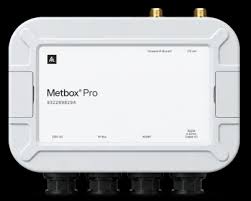
Connectivity has to be chosen around those conditions. Metbox's technology mix covers Wireless M-Bus/OMS, LoRaWAN, NB-IoT, wired M-Bus and Modbus. Its hardware includes mains- and battery-powered Wireless M-Bus gateways and the multi-protocol Metbox Pro range, with backhaul over 4G/LTE.
Data quality, cybersecurity, remote device management and integration are built into the platform alongside monitoring and control. The Metbox team includes specialists with 20 years in telemetry and IT, and their experience has produced one clear principle: modernise on top of compatible existing equipment, and leave room for what comes next. No forced replacements, no single-vendor dependency.
WHAT COMES NEXT: PREDICTION AND CONTROLLED ACTION
Metering data is becoming a digital layer of infrastructure, not only for individual utilities but for the management of towns, cities and regions. The next step is linking monitoring with prediction and controlled action. Digital twins are a near-term development priority for Metbox: models informed by measurements, weather and equipment behaviour, used to evaluate operating scenarios before touching the real system. In district heating, that means comparing control strategies and estimating their effect on consumption and indoor comfort before implementation.
Metbox's research and development builds on eleven years of operational data to advance interoperability, secure remote control and validation under real conditions. Priorities for the coming years are stronger analytics, AI and digital-twin capability, secure remote control and continued international growth. Developing hardware and software together allows the company to move these forward as one system.
"Our ambition is straightforward," said Skrastiņš. "Help customers understand their infrastructure today, improve how it operates tomorrow, and make better-informed decisions about its future."
Metbox will exhibit at Enlit Europe in Vienna, 10–12 November 2026.
About Metbox
SIA Metbox, founded in 2015 and based in Mārupe, Latvia, develops remote meter reading gateways and a data platform for water utilities, district heating operators, municipalities, property managers and industrial sites. Metbox connects more than 18,000 devices for 150+ clients across Europe and is deployed in five export markets. Its solutions work with a wide range of existing meters, so in many cases operators can modernise without replacing installed equipment.
Jana Medova
SIA METBOX
+371 20 427 173
marketing@metbox.com
Visit us on social media:
LinkedIn
Instagram
YouTube
How Metbox connects existing water and heat meters to one data platform
Legal Disclaimer:
EIN Presswire provides this news content "as is" without warranty of any kind. We do not accept any responsibility or liability for the accuracy, content, images, videos, licenses, completeness, legality, or reliability of the information contained in this article. If you have any complaints or copyright issues related to this article, kindly contact the author above.
